



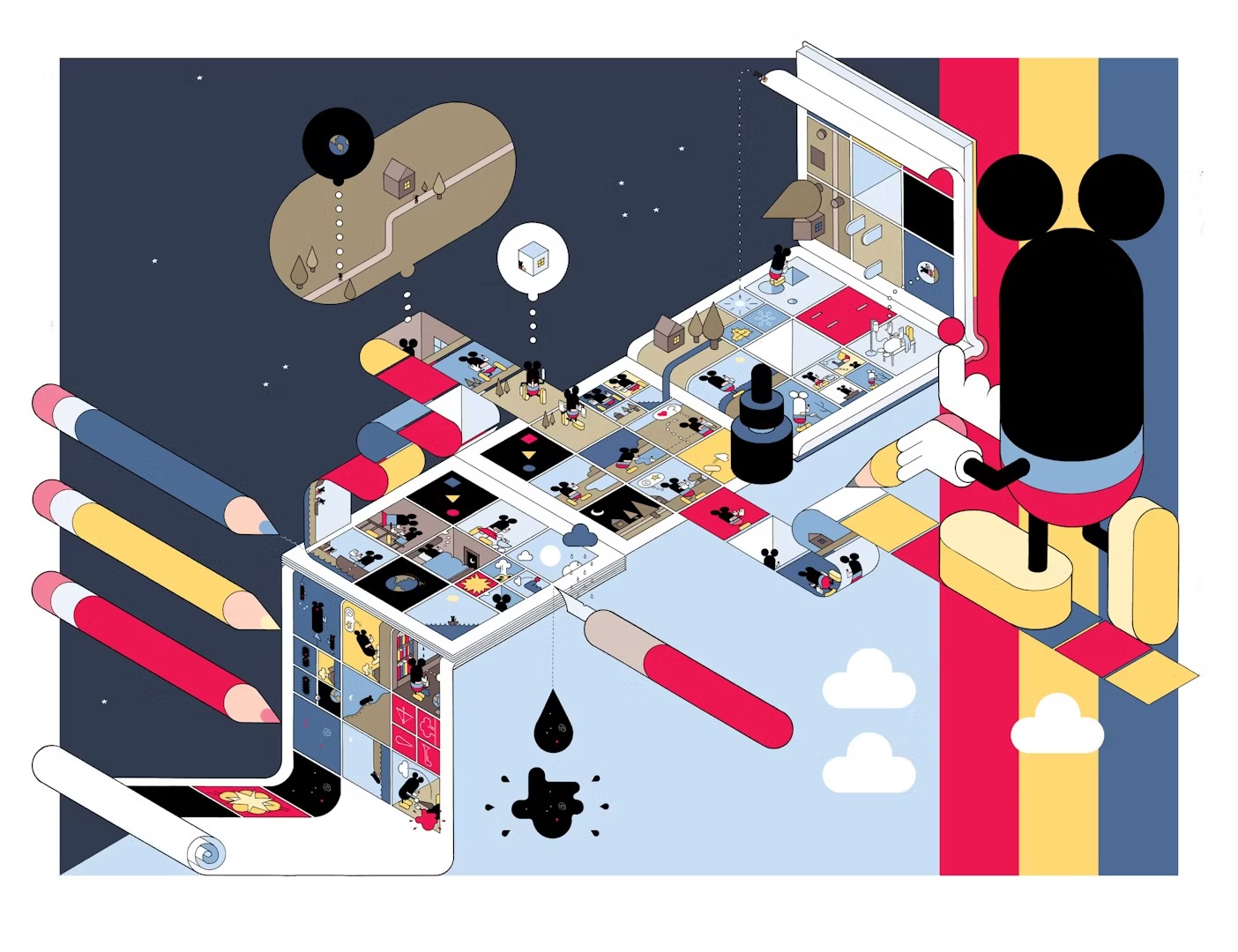
At first glance, comics and graphic design seem like different worlds. Comics tell stories with panels, characters, and speech balloons; graphic design solves problems with logos, posters, and layouts. Yet the two disciplines are closer than they appear. Both are built on the same foundation: the need to communicate visually with clarity, impact, and emotion. To understand one is, in many ways, to understand the other.
The histories of comics and graphic design run side by side, often crossing paths. In the early twentieth century, newspaper comics borrowed from the visual energy of advertising and poster design2. The stylised curves of Art Nouveau, the bold geometry of Constructivism, and the strict order of the Bauhaus all found their way into comics’ visual language.
At the same time, graphic design borrowed back. Pop Art in the 1960s made comics central to its vocabulary—Roy Lichtenstein’s paintings turned comic panels into icons of modern art3. Underground comix shaped the DIY aesthetics of punk fanzines, which in turn influenced graphic design4. Both comics and design thrived in print culture, sharing the same presses, the same readers and often similar visual ideas.
Common Ground: Principles and ToolsStrip away the subject matter and both comics and design rely on the same principles.
- Composition: A comic page is a grid of meaning; a poster is a single-frame story. Both demand careful attention to hierarchy, balance and rhythm5.
- Typography and Lettering: In comics, a jagged speech balloon screams louder than words alone. In design, expressive type carries as much emotion as an image. Scott McCloud describes comics lettering as part of their “iconic system.6”
- Colour Theory: Early comics, restricted by cheap printing, relied on flat, bold colours7. Modernist designers used similar palettes for clarity and impact. Today, both fields exploit colour as shorthand for mood, tone and identity.
- Sequential Thinking: Comics are sequential by nature, but designers also think in sequence when working on multi-page brochures, websites, or brand systems. Edward Tufte’s work on visual information design resonates strongly with McCloud’s discussion of panel-to-panel flow8.
Many creators move fluidly between the two worlds. For instance, Graphic designer Rian Hughes has written and drawn comics, applying his sleek design sense to the page9. Comic artist Chris Ware is celebrated for his mastery of typography and layout—his pages often resemble modernist design posters10. Dutch cartoonist Joost Swarte has designed stamps, posters and even architecture, all infused with his ligne claire cartoon style.
Even mainstream superhero comics show this crossover. Think of Superman’s ‘S’ shield or Batman’s bat symbol: these are logos as much as costumes, instantly recognisable pieces of graphic design. Comics have given us some of the most enduring “brands” of the twentieth century.
The Digital EraToday, the overlap is stronger than ever. The same tools – Illustrator, Photoshop, InDesign, Clip Studio – are used by both designers and cartoonists. Motion graphics bring comic-style storytelling into advertising and UI design. Infographics and data comics blur the line between information design and sequential art11.
On social media, the convergence is clear. Comics adapt to scrolling grids and swipeable panels, while designers increasingly use narrative structures to engage audiences. Both fields are shaped by the same digital constraints and possibilities.
Cultural ImpactPerhaps the most powerful link between comics and graphic design is their shared cultural role. Both are accessible art forms that reach wide audiences. A striking poster on the street and a powerful comic on a newsstand both carry messages that cut through barriers of language or education. From satirical cartoons of the 19th century to the bold graphic identities of modern protest movements, both have been central to visual culture12.
Logos, symbols and icons born in comics (the Superman shield, the X-Men ‘X’) live in the same cultural space as Nike’s swoosh or Apple’s bitten apple. They are shorthand for entire mythologies, carrying stories in their design.
ConclusionComics and graphic design are not distant cousins, but siblings. Both emerged from the same world of mass print culture, both share a toolkit of visual principles and both continue to influence one another. For a designer, studying comics is a way to sharpen storytelling skills. For a cartoonist, understanding design is a way to strengthen clarity and communication.
In the end, both fields remind us that pictures and words, arranged with care, can move people. Whether it’s a sequence in a graphic novel or a poster in the street, the goal is the same: to catch the eye, speak to the mind and to leave a lasting mark.
Brad loves talking about graphic design as much as he likes talking about comics, so if you’d like to find out more, please get in touch.
Let’s create something brilliant together.
- Poetry, Design & Comics. An Interview with Seth: Carousel 19, Spring/Summer 2006. Reprinted in Sethphemera, Máquina de Aplausos, 2025. ↩︎
- Duncan, Randy & Smith, Matthew. The Power of Comics: History, Form and Culture. Bloomsbury, 2009. ↩︎
- Livingstone, Marco. Pop Art: A Continuing History. Thames & Hudson, 2000. ↩︎
- Triggs, Teal. Fanzines: The DIY Revolution. Chronicle Books, 2010. ↩︎
- Meggs, Philip B. & Purvis, Alston. A History of Graphic Design. Wiley, 2016. ↩︎
- McCloud, Scott. Understanding Comics: The Invisible Art. HarperCollins, 1993 ↩︎
- Sabin, Roger. Comics, Comix & Graphic Novels: A History of Comic Art. Phaidon, 1996. ↩︎
- Tufte, Edward. The Visual Display of Quantitative Information. Graphics Press, 2001 ↩︎
- Hughes, Rian. Logo a Gogo: Branding Pop Culture. Korero Press, 2018 ↩︎
- Ball, Dan. Chris Ware: Monograph. Rizzoli, 2017 ↩︎
- Sousanis, Nick. Unflattening. Harvard University Press, 2015 ↩︎
- Dunn, Louise. Protest! A History of Social and Political Graphics. Laurence King, 2020 ↩︎