Why do neuromyths persist?
One of the really useful things I've learned during my Master's in Applied Neuroscience is why many of the things people confidently "know" about the brain aren't actually true:
- We only use 10% of our brains.
- People are either left-brained or right-brained.
- We all have a preferred learning style.
- The reptilian brain is responsible for our instincts.
These ideas appear regularly in leadership development, education, the media (often with a lovely colourful picture of a brain scan for added authenticity!) and everyday conversation, but the evidence for them is weak, outdated or simply wrong.
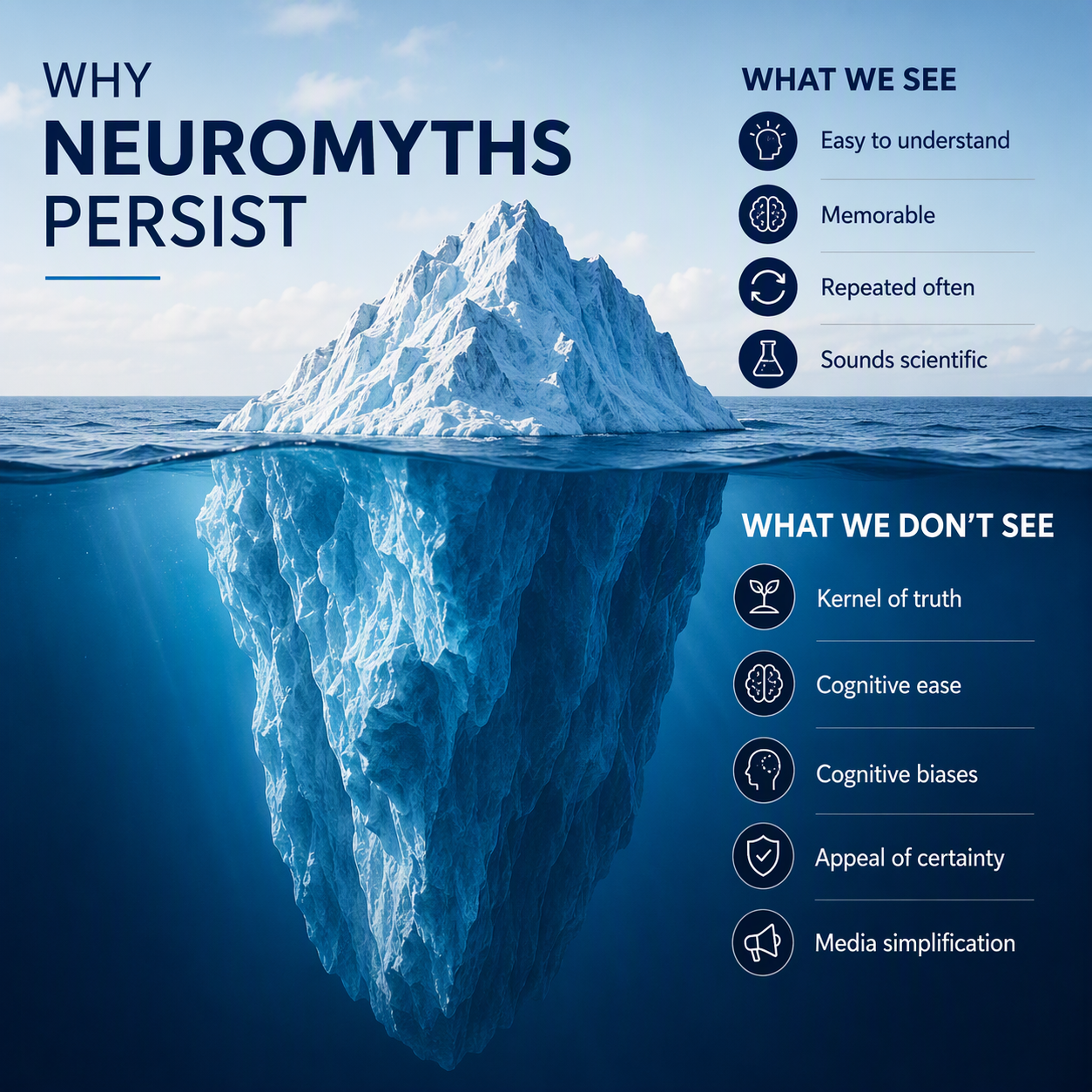
So why do they persist? Partly because good myths usually contain a kernel of truth:
- We don't literally use only 10% of our brains, but different brain networks become active during different tasks.
- We aren't left-brained or right-brained people, but some functions are more associated with particular regions.
- Learning preferences exist, but there is little evidence that matching teaching to a preferred learning style improves learning.
- And whilst the idea of a "reptilian brain" is an oversimplification, human brains do contain ancient structures involved in survival, threat detection and basic physiological processes.
The problem is that nuance rarely travels as well as certainty. Neuroscience is complicated and, despite significant advances, there is still much we don't fully understand. Stories are simple, and our brains prefer simple.
This is where cognitive ease comes in. Information that is easy to understand feels more familiar, more comfortable and often more believable. An elegant myth can therefore be far more persuasive than an accurate explanation.
Ironically, understanding this may be a useful lesson neuroscience offers leaders. The challenge isn't that people believe myths, it is that all of us are susceptible to explanations that feel right whether we're talking about brains, organisations, strategy or people.
After all, many organisational myths persist for the same reasons as neuromyths. Perhaps leaders should reframe their questioning from:
"Is this true?"
To:
"Why does this feel so convincing?"