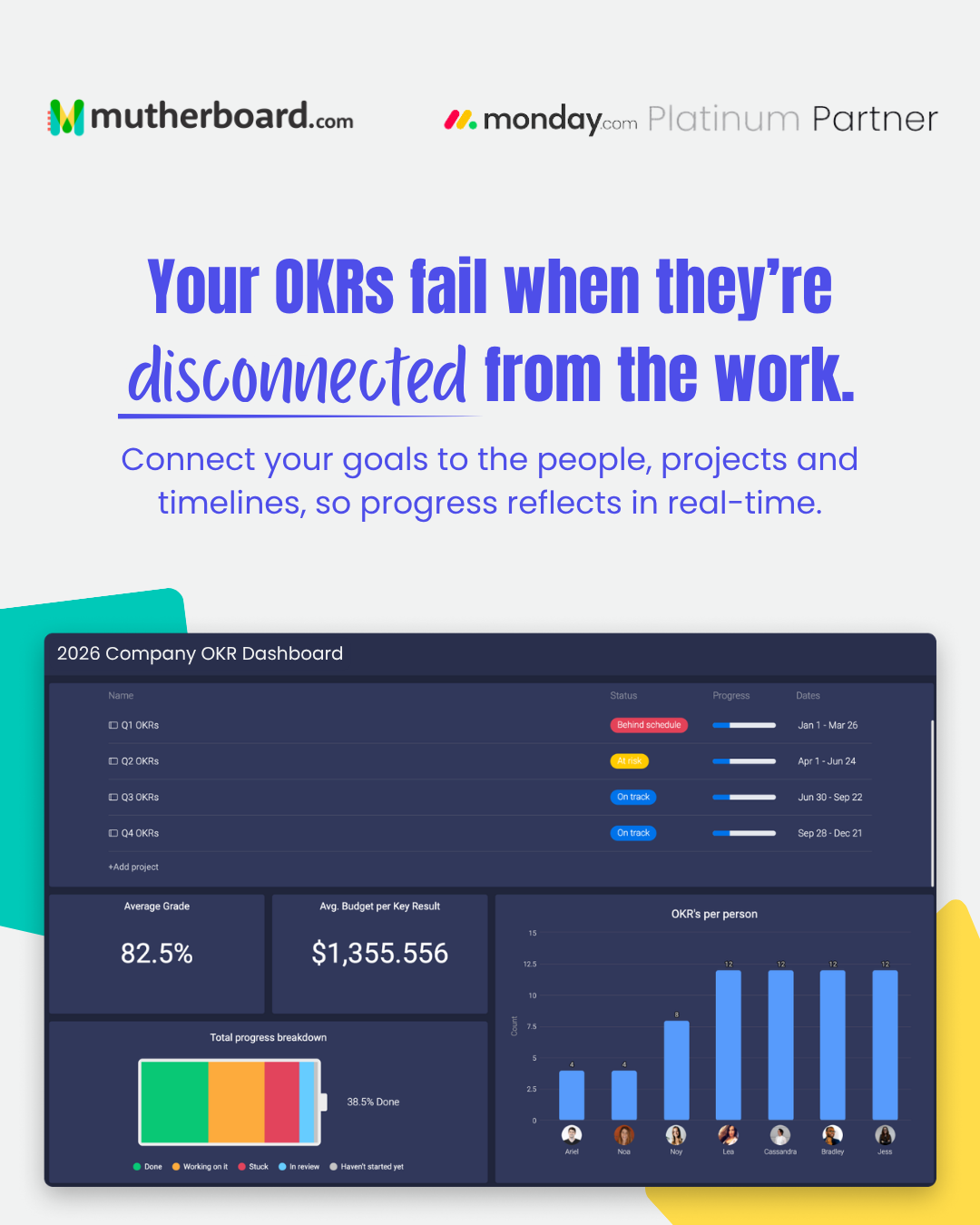
You can spend hours crafting the perfect OKRs.
The objectives are ambitious. The key results are measurable. Everyone nods along in the planning meeting. There might even be a beautifully designed presentation involved.
Then everyone goes back to work.
And that is often where things start to unravel.
Because while your OKRs are sitting neatly in a strategy document, spreadsheet or presentation, the actual work is happening somewhere else entirely.
Projects are being managed in one place. Tasks are assigned in another. Teams are having conversations elsewhere. Before long, checking progress against a company objective means asking around, chasing updates and trying to piece together a story from half a dozen different sources.
The issue is not necessarily that your goals are wrong.
It is that they are disconnected from the work meant to achieve them.
A goal without connected work is just a good intention
Let's say one of your company objectives is to improve customer retention.
Great. But what projects are contributing to that goal?
Which teams are responsible for the work?
What tasks need to be completed?
Are those projects progressing as planned?
Are there risks that could affect the outcome?
And perhaps most importantly, can you answer any of those questions without scheduling another status meeting?
When OKRs and day-to-day work are disconnected, progress reporting becomes manual. Teams are asked for updates, managers interpret those updates and someone eventually turns everything into a traffic light.
Green. Amber. Red.
The problem is that those colours often tell you how someone feels about progress rather than what is actually happening.
A project can be marked as "on track" right up until it suddenly isn't.
The reporting trap
Disconnected OKRs tend to create a familiar cycle.
Leadership wants an update.
Managers ask their teams for progress.
Teams stop what they are doing to compile updates.
Someone puts the information into a report.
The report is presented.
Everyone agrees to check again next month.
Meanwhile, the actual work continues, often without any clearer connection to the bigger business goals.
It is a lot of effort spent describing progress rather than enabling it.
And the irony is that most organisations already have the information they need. The data exists in projects, tasks, timelines and workflows. It just is not connected in a way that makes the bigger picture easy to see.
Connect strategy to execution
This is where connected work management makes a real difference.
Imagine being able to start with a company objective and immediately see the projects contributing towards it.
From there, you can see the workstreams, timelines, owners and progress. If a key project starts slipping, you can identify the potential impact on the objective much earlier.
That changes the conversation.
Instead of asking:
"How are we doing against this objective?"
You can ask:
"What is affecting progress, and what should we do about it?"
That is a much more useful question.
Connecting OKRs to the work also helps teams understand why their work matters. It is easy for employees to become focused on ticking off tasks without seeing how those tasks contribute to something bigger.
When the connection is visible, a task is no longer just another item on a to-do list. It becomes part of a wider effort to move the organisation forward.
Real-time visibility beats retrospective reporting
Traditional reporting is often retrospective.
It tells you what happened last week, last month or last quarter.
Connected OKRs give you a more current view.
You can monitor progress as work happens, rather than waiting for someone to manually update a report. You can spot bottlenecks earlier and identify projects that are at risk before they become major problems.
Of course, no dashboard can magically make a struggling project successful.
Sorry to disappoint the dashboard enthusiasts.
But visibility gives leaders and teams the opportunity to intervene sooner. And in project management, timing matters.
Finding out about a problem when there is still time to fix it is very different from discovering it in a quarterly review.
Better alignment, fewer surprises
When OKRs are connected to projects and workflows, alignment becomes easier to maintain.
Teams can see what they are working towards.
Managers can understand where effort is being invested.
Leadership can see whether strategic priorities are actually reflected in the work being done.
It also helps answer an important question that many businesses struggle with:
Are we busy with the right things?
Because being busy is not the same as making progress.
A team can be incredibly productive while working on initiatives that have very little impact on the organisation's priorities. Connecting goals to execution makes it easier to identify that disconnect.
Make your goals part of the work
OKRs should not be something you revisit once a quarter and hope for the best.
They should be part of how work is planned, prioritised and measured every day.
The goal is not to create more dashboards or introduce another reporting process. It is to create a clearer connection between strategy and execution.
When your goals, projects and timelines are working together, progress becomes easier to understand.
Less chasing.
Less guessing.
Less manually updating slides at 4pm on a Friday.
And more confidence that the work happening across your organisation is actually moving you towards the goals you set.
Because a brilliant strategy is only useful if it makes its way into the work.
Need help connecting your OKRs, projects and workflows? Mutherboard can help you build systems that give your teams clearer visibility from strategy through to execution.