
Leadership: The Human Factor
For over 30 years, I've worked in HR and Leadership Development, and I've been lucky enough to work with a wide range…



cordialadvisory.co.uk/journal/iso-9001-readiness-check
I have spent most of my career on the operational side of small and mid-sized UK manufacturers. Machine shops, fabricators, joinery workshops, electronics assembly. Every one of them proud of what they made, most of them running quality work day in and day out, and a surprising number of them convinced they were miles away from being ISO 9001 certifiable.
Almost always, they were closer than they thought.
The gap between where a growing UK manufacturer actually stands and where ISO 9001 asks them to be is smaller than the standard's reputation suggests. What most businesses lack is not the quality itself. It's the evidence that the quality exists in a form an auditor can look at.
The three most common conversations
The first conversation is with the shop that already runs well. The operators know their machines, the setters know their tolerances, the fitters know the standard. Ask any of them how a particular process runs and they will describe it accurately in ten minutes at the bench. Ask them where it is written down and the answer is a shrug. The quality is real. The record of it is not.
The second conversation is with the shop that has grown quickly. A business that was six people three years ago is now eighteen, and the practices that worked when everyone could shout across the workshop no longer work now that half the team hasn't met the other half. Problems get fixed but not logged. Complaints get resolved but not tracked. Suppliers get chosen but not reviewed. Nothing is broken. Nothing is written down either.
The third conversation is with the shop whose largest customer has just asked for certification. The customer has grown, or been acquired, or lost patience with un-certified suppliers, and the message has come down that certification is expected within twelve months. The shop knows it must comply. The shop also knows it doesn't have a clear picture of what compliance actually involves.
In all three cases, the operational reality of the business is already close to what the standard asks for. The distance to certification is not in the workshop. It is in the paperwork.
What ISO 9001 is actually testing
The most useful way to think about ISO 9001 is not as a test of whether your business is any good, but as a test of whether your business can be shown to be any good. Those are different things.
An auditor cannot look at a machine setter and know from watching them that they were trained properly. They can only look at a training record and see the date, the topic, and the sign-off. If the training happened but the record does not exist, the business fails the test. The training itself was real. The evidence of it was not.
The same principle runs through most of the standard. Are your processes controlled? Prove it. Are your customer requirements captured? Show me. Do you learn from complaints? Show me what changed. Are your gauges reliable? Show me the certificates.
None of this is a test of whether your business is well-run. It is a test of whether your business is provably well-run. That distinction is what most ISO 9001 conversations get wrong, and it is why so many good businesses talk themselves out of pursuing certification when they are actually most of the way there.
Where the real work sits
For a business that has decided to pursue certification, or that is being pushed to by a customer, the actual work sits in five areas. Documented procedures written the way the team actually does the job. Training records that show who is signed off on what and when. A calibration schedule and a certificate folder that an auditor can look at without asking twice. A problem log with recorded closures. A quality review that happens on a schedule, with written actions.
None of that is difficult. All of it takes time, and most of it takes the kind of steady, boring discipline that gets deprioritised the first time the workshop gets busy. That is the honest reason most shops that could be certified in six months take eighteen.
The other honest reason is that the standard uses language that discourages people. Nonconformity. Corrective action. Continual improvement. These are all reasonable technical terms that read as jargon on a first pass, and a shop that already has a full week is not going to spend an evening decoding a management standard when the work will be there again tomorrow.
Where to start
The most useful first step for any business thinking about ISO 9001 is honest self-assessment. Not against the standard itself, which is dense and long, but against a plain-English version of what the standard actually asks.
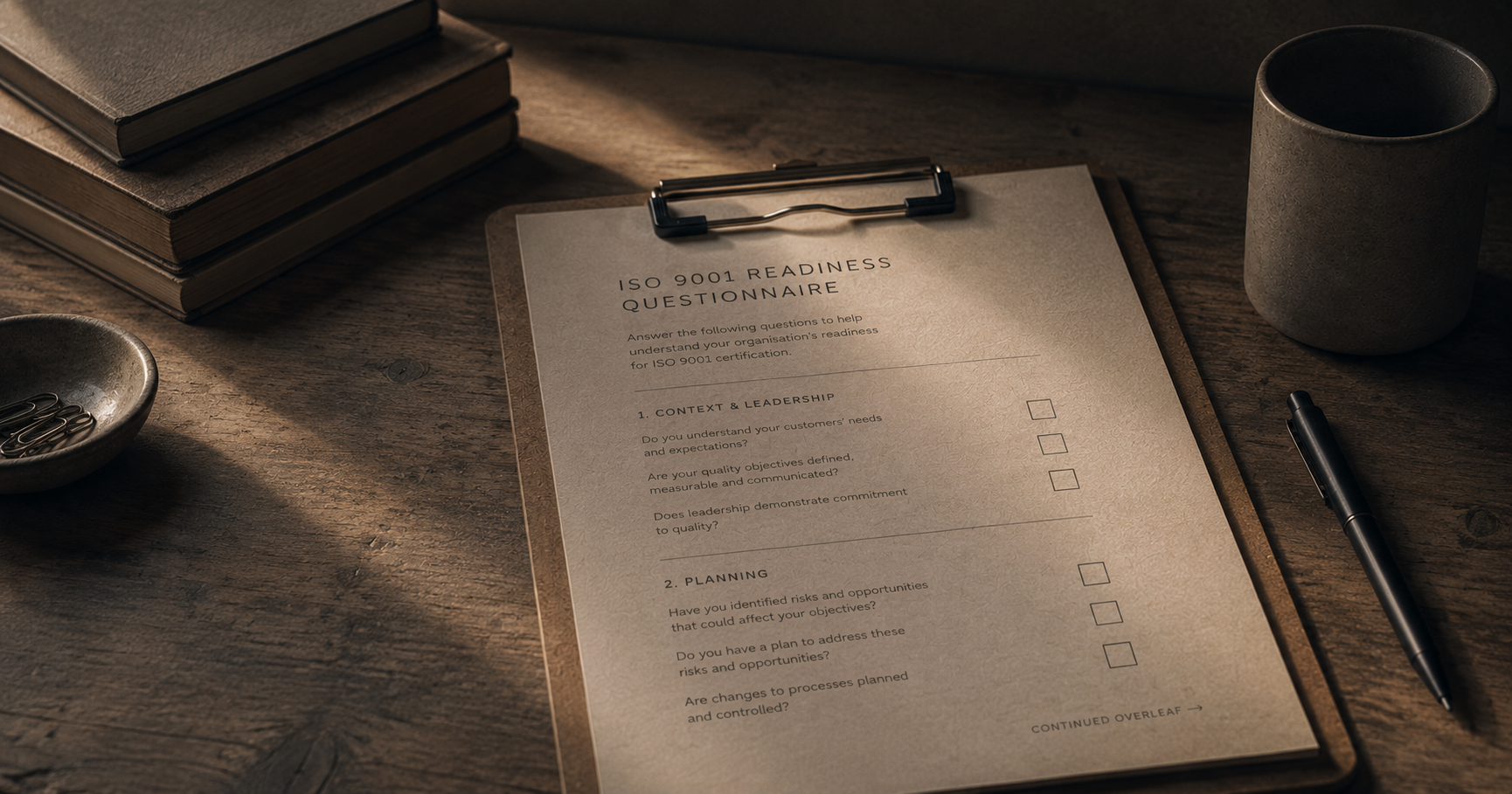
We have built a short readiness check on our website. Fifteen yes-or-no questions, about ten minutes to complete. It gives you a score straight away, and a written breakdown by email showing where the gaps are and a first-fix plan for the one that would make the biggest difference.
It is free, and there is no hard sell attached. Even if you never take it further with us, the results will tell you honestly where you stand.
For any business being asked by a customer to certify, or thinking about certification, or simply curious whether your operation would pass, it is worth ten minutes.
cordialadvisory.co.uk/journal/iso-9001-readiness-check
By Anthony Pothecary, Co-founder, Cordial Advisory